
The air we breathe is essential to our health and productivity. In the workplace, air quality directly impacts both the well-being of employees and the financial performance of a business. Poor air quality can lead to various health issues, reduced productivity, and potential legal ramifications for employers. While industrial and commercial settings have historically faced challenges in this regard, the increasing awareness of air quality’s importance has led to better measurement tools, stricter regulations, and greater ethical considerations. This forces us to explore the economic and ethical dimensions of air quality in the workplace, highlighting historical issues, current regulations, measurable elements, and the technologies and financial plans companies can use to implement air quality standards.
Historical Problems and the Legal Minimum
Historically, air quality in workplaces has rarely been prioritized. In many of these cases, companies did the minimum required by law—sometimes, not even that. For decades, labour laws were minimal or non-existent, leaving workers vulnerable to long-term health damage. Even when regulations began to take shape in the mid-20th century, compliance was often a matter of meeting the legal threshold rather than striving for the best possible air quality for employees. This drives the questions around whether air-quality monitoring and handling is more than an ethical and compliance obligation and can it make a positive financial contribution to the business. On the positive side, many employers and employee today have now generally come to a consensus that a do-nothing policy is unacceptable and there’s an obligation to do what realistic and reasonable to ensure people’s safety.
What’s Measurable?
There are several elements in the air that can be measured in a workplace to determine air quality. Some of these are naturally occurring, while others are the result of human activity.
1. Particulate Matter (PM): These are tiny particles suspended in the air. They can originate from dust, fumes, and combustion processes. Exposure to particulate matter can cause respiratory issues, cardiovascular diseases, and exacerbate existing conditions like asthma. PM can be measured using PM2.5 and PM10 sensors, which measure particles smaller than 2.5 micrometers and 10 micrometers in diameter, respectively. PM2.5 concentrations should be below 10 µg/m³ annually and 25 µg/m³ for 24-hour averages.
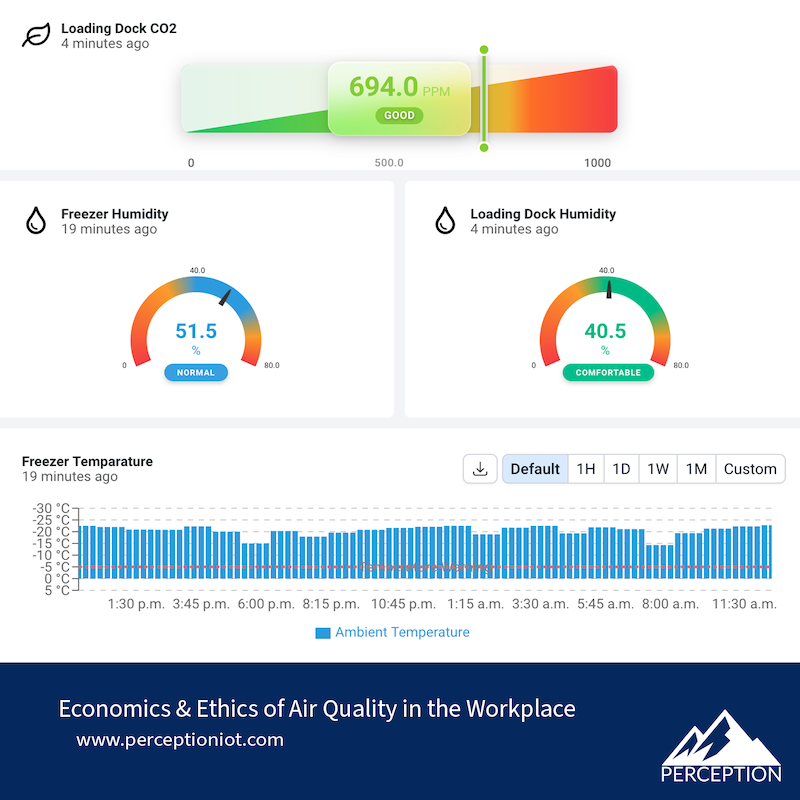
2. Carbon Dioxide (CO2): CO2 is a byproduct of human respiration, combustion processes, and certain industrial activities. High levels of CO2 in confined spaces can cause headaches, dizziness, fatigue, and in extreme cases, even asphyxiation. Levels should be kept below 1,000 ppm through maintaining proper ventilation.
3. Volatile Organic Compounds (VOCs): VOCs are a group of chemicals found in solvents, paints, adhesives, and even office equipment. They can evaporate into the air, causing various health issues. VOCs can cause headaches, nausea, dizziness, and long-term exposure has been linked to cancer and liver damage. Efforts have been made to reduce the amount of VOCs including in everyday items like interior paints. The acceptable concentration of VOCs varies by specific chemical, and knowing what may be present in your environment is the first step.
4. Ozone (O3): We often think of Ozone in the terms of a hole in our atmosphere, but ozone is often a byproduct of industrial processes and is also found in photocopiers, laser printers, and other machinery. Breathing ozone can cause respiratory problems, irritation of the eyes and throat, and exacerbate asthma. Limiting exposure to 0.1 ppm over an 8-hour workday has been documented as an acceptable threshold.
5. Carbon Monoxide (CO): Carbon monoxide is a colourless, odourless gas produced by combustion processes. In a workplace setting, it can accumulate in poorly ventilated areas. Carbon monoxide is particularly dangerous because it can cause poisoning without immediate symptoms. Exposure to high concentrations can lead to dizziness, confusion, and even death. Permissible exposure limit is 50 ppm over an 8-hour workday.
How to Measure and Adapt
With advances in technology, companies now have access to various tools to monitor and improve air quality. Some of these technologies include:
• Indoor Air Quality (IAQ) Sensors: These sensors can measure a range of pollutants, including particulate matter, CO2, VOCs, ozone, and carbon monoxide.
• Ventilation Systems: Modern HVAC (heating, ventilation, and air conditioning) systems come equipped with filters that can remove dust, particulate matter, and VOCs.
• Air Purifiers: HEPA filters and activated carbon filters can effectively reduce particulate and chemical pollutants.
• Environmental Sensor Networks: Integrated into larger building systems or standalone, wireless IAQ Sensors are interconnected providing users with real-time dashboards and alerts as well as historical data to build a larger picture.
Making the Case
Investing in air quality improvements can lead to increased productivity and can reduce absenteeism and increase employee efficiency. Reducing the risk of respiratory diseases and other health problems can lower healthcare costs while proactively improving air quality can prevent costly fines and legal issues. Companies that prioritize employee health and well-being may see increased retention and morale. ROI can be measured by tracking reductions in absenteeism, improved employee output, and savings on health insurance and medical claims.
The options to implementing a next-generation air quality system are varied and customizable to suit virtually any budget. Starting small and with a long-term vision is arguably better than waiting for the perfect time or miracle budget. Wireless technologies including Low-Power Wide-Area Networks (LPWANs) have emerged as a cost-effective solution into sensor management and with ability to scale as time and budgets allow.
The economics and ethics of air quality in the workspace are intertwined. Employers have both a legal obligation and an ethical duty to provide a safe, healthy work environment. With the right technology, measuring tools, and a solid financial plan, businesses can ensure that air quality standards are met, leading to a healthier workforce and improved long-term business outcomes. Work with a qualified professional to further understand the options available and how to most effectively develop a migration plan that’s right for you.
#IOT #EnvironmentalMonitoring #AirQuality #LoRaWAN #HVAC #PerceptionIOT