Let’s be direct: environmental monitoring and resource management are no longer a “nice to have” line item on next year’s capital plan. It is a financial and regulatory imperative and the cost of inaction is quietly growing every quarter you wait.
As someone responsible for the performance and compliance of a facility, you sit at the intersection of budgets, occupant safety, regulatory scrutiny, and sustainability commitments. The good news is that today’s environmental monitoring and resource management technologies offer a rare combination: they reduce operating costs, strengthen compliance posture, and create measurable ROI, often within the first year of deployment.
The Regulatory Landscape Is Tightening
Environmental compliance obligations have expanded significantly in recent years, and enforcement is becoming less forgiving. Depending on your sector and jurisdiction, you may already be subject to requirements governing indoor air quality, water discharge, energy benchmarking, and greenhouse gas reporting. Facilities that fail to document and demonstrate compliance face fines, operational shutdowns, and reputational damage that is difficult to reverse.
Energy benchmarking mandates are expanding at a multiple of governmental levels, requiring some building owners to report annual energy and water consumption. For universities and large commercial facilities, this is no longer optional, it is a public-facing obligation. Organizations caught without reliable data infrastructure scramble to retroactively piece together records that automated monitoring would have captured continuously.
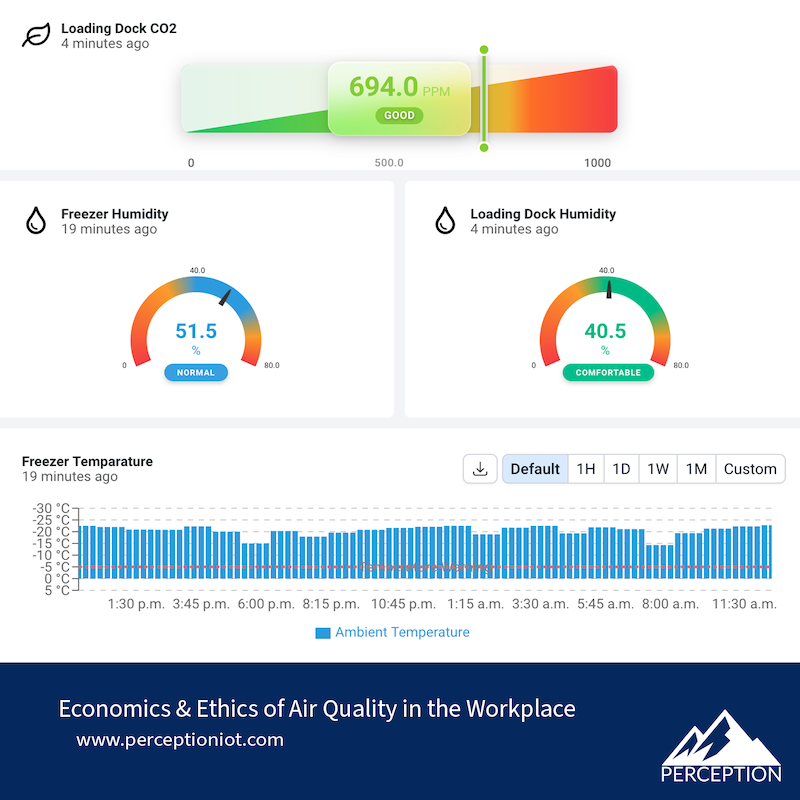
Indoor air quality (IAQ) standards are under similar pressure. Many guidelines, local occupational health codes, and post-pandemic building standards all point toward continuous monitoring of CO2, particulate matter, and VOCs as an expectation, not an exception. When a regulator, insurer, or major tenant asks for your air quality data, the ability to produce time-stamped, automated records is a fundamentally different conversation than explaining you conduct periodic manual checks.
Water and Energy: Where the Financial Case Gets Compelling
Water and energy represent two of the largest controllable cost centers in any facility budget, and they are also among the least visible without proper monitoring infrastructure. Studies consistently show that buildings with real-time energy monitoring reduce consumption by 10–20% compared to unmonitored facilities, simply because visibility creates accountability and enables faster corrective action.
Water leaks are a particularly painful example of avoidable loss. A single undetected pipe failure in a mechanical room, irrigation system, or rooftop unit can cost tens of thousands of dollars before anyone notices. Wireless leak detection sensors, when integrated into a broader monitoring platform, alert facility teams within minutes. The sensor pays for itself the first time it catches a leak before it becomes a flood.
The financial benefits compound across several categories:
• Energy Savings: Automated identification of HVAC inefficiencies, after-hours equipment running, and thermal anomalies can reduce utility spend by 15% or more annually.
• Predictive Maintenance: According to Deloitte, predictive maintenance programs reduce equipment breakdowns by up to 70% and cut maintenance costs by 25%, translating directly to avoided capital expenditure.
• Water Conservation: Sub-metering and leak detection reduce water costs and protect against infrastructure damage, with payback periods often under 18 months.
• Insurance and Liability: Documented environmental data supports insurance claims, demonstrates due diligence, and in some jurisdictions qualifies facilities for reduced premiums.
The Risk of Inaction Is Real
It is tempting to defer these investments when budgets are constrained, but the cost of inaction rarely stays static. An unmonitored mechanical system that fails mid-winter does not just create a repair bill, it creates occupant complaints, potential health claims, possible regulatory scrutiny, and damaged trust with the building’s stakeholders. For a university campus, a residence or lab incident tied to air quality or water system failure carries reputational consequences that go well beyond the facility budget.
Sustainability commitments made at the institutional or corporate level also increasingly require verifiable data. If your organization has pledged net-zero targets or ESG reporting milestones, facility management is on the hook for the numbers. Without an automated monitoring backbone, those targets become difficult to track, difficult to report, and difficult to defend.
A Scalable Path Forward
The practical barrier to getting started is lower than most realize. Modern wireless sensor networks, including Low-Power Wide-Area Networks (LPWANs) are far less costly to deploy than legacy wired systems. A single facility or building zone can serve as a cost-effective proof of concept, validating ROI before a broader rollout. There is no need to solve everything at once. A phased approach, guided by a qualified integrator, allows you to start where the risk or opportunity is greatest and build from there.
The key is selecting a partner who understands not just the technology, but the specific operational, regulatory, and financial context of your facility type whether that is a logistics hub, a commercial property portfolio, or a multi-building university campus. The right integrator will help you build a total cost of ownership model that makes the decision clear and defensible to your stakeholders.
The facilities that get ahead of these obligations now will be better positioned for future compliance requirements. Those that wait will spend more to catch up under pressure, and on someone else’s timeline.
If you’d like to talk through what environmental monitoring could look like for your specific facility, we’d welcome the conversation. Sometimes it takes just one honest discussion to see where the real value is and how quickly it can be realized.
#IOT #EnvironmentalMonitoring #ResourceManagement #AirQuality #LoRaWAN #PerceptionIOT