Author: Perception

  • The Business Case for Environmental Monitoring

    The Business Case for Environmental Monitoring

    Let’s be direct: environmental monitoring and resource management are no longer a “nice to have” line item on next year’s capital plan. It is a financial and regulatory imperative and the cost of inaction is quietly growing every quarter you wait.

    As someone responsible for the performance and compliance of a facility, you sit at the intersection of budgets, occupant safety, regulatory scrutiny, and sustainability commitments. The good news is that today’s environmental monitoring and resource management technologies offer a rare combination: they reduce operating costs, strengthen compliance posture, and create measurable ROI, often within the first year of deployment.


    The Regulatory Landscape Is Tightening

    Environmental compliance obligations have expanded significantly in recent years, and enforcement is becoming less forgiving. Depending on your sector and jurisdiction, you may already be subject to requirements governing indoor air quality, water discharge, energy benchmarking, and greenhouse gas reporting. Facilities that fail to document and demonstrate compliance face fines, operational shutdowns, and reputational damage that is difficult to reverse.

    Energy benchmarking mandates are expanding at a multiple of governmental levels, requiring some building owners to report annual energy and water consumption. For universities and large commercial facilities, this is no longer optional, it is a public-facing obligation. Organizations caught without reliable data infrastructure scramble to retroactively piece together records that automated monitoring would have captured continuously.

    Indoor air quality (IAQ) standards are under similar pressure. Many guidelines, local occupational health codes, and post-pandemic building standards all point toward continuous monitoring of CO2, particulate matter, and VOCs as an expectation, not an exception. When a regulator, insurer, or major tenant asks for your air quality data, the ability to produce time-stamped, automated records is a fundamentally different conversation than explaining you conduct periodic manual checks.


    Water and Energy: Where the Financial Case Gets Compelling

    Water and energy represent two of the largest controllable cost centers in any facility budget, and they are also among the least visible without proper monitoring infrastructure. Studies consistently show that buildings with real-time energy monitoring reduce consumption by 10–20% compared to unmonitored facilities, simply because visibility creates accountability and enables faster corrective action.

    Water leaks are a particularly painful example of avoidable loss. A single undetected pipe failure in a mechanical room, irrigation system, or rooftop unit can cost tens of thousands of dollars before anyone notices. Wireless leak detection sensors, when integrated into a broader monitoring platform, alert facility teams within minutes. The sensor pays for itself the first time it catches a leak before it becomes a flood.

    The financial benefits compound across several categories:

    • Energy Savings: Automated identification of HVAC inefficiencies, after-hours equipment running, and thermal anomalies can reduce utility spend by 15% or more annually.

    • Predictive Maintenance: According to Deloitte, predictive maintenance programs reduce equipment breakdowns by up to 70% and cut maintenance costs by 25%, translating directly to avoided capital expenditure.

    • Water Conservation: Sub-metering and leak detection reduce water costs and protect against infrastructure damage, with payback periods often under 18 months.

    • Insurance and Liability: Documented environmental data supports insurance claims, demonstrates due diligence, and in some jurisdictions qualifies facilities for reduced premiums.


    The Risk of Inaction Is Real

    It is tempting to defer these investments when budgets are constrained, but the cost of inaction rarely stays static. An unmonitored mechanical system that fails mid-winter does not just create a repair bill, it creates occupant complaints, potential health claims, possible regulatory scrutiny, and damaged trust with the building’s stakeholders. For a university campus, a residence or lab incident tied to air quality or water system failure carries reputational consequences that go well beyond the facility budget.

    Sustainability commitments made at the institutional or corporate level also increasingly require verifiable data. If your organization has pledged net-zero targets or ESG reporting milestones, facility management is on the hook for the numbers. Without an automated monitoring backbone, those targets become difficult to track, difficult to report, and difficult to defend.


    A Scalable Path Forward

    The practical barrier to getting started is lower than most realize. Modern wireless sensor networks, including Low-Power Wide-Area Networks (LPWANs) are far less costly to deploy than legacy wired systems. A single facility or building zone can serve as a cost-effective proof of concept, validating ROI before a broader rollout. There is no need to solve everything at once. A phased approach, guided by a qualified integrator, allows you to start where the risk or opportunity is greatest and build from there.

    The key is selecting a partner who understands not just the technology, but the specific operational, regulatory, and financial context of your facility type whether that is a logistics hub, a commercial property portfolio, or a multi-building university campus. The right integrator will help you build a total cost of ownership model that makes the decision clear and defensible to your stakeholders.

    The facilities that get ahead of these obligations now will be better positioned for future compliance requirements. Those that wait will spend more to catch up under pressure, and on someone else’s timeline.

    If you’d like to talk through what environmental monitoring could look like for your specific facility, we’d welcome the conversation. Sometimes it takes just one honest discussion to see where the real value is and how quickly it can be realized.

    #IOT #EnvironmentalMonitoring #ResourceManagement #AirQuality #LoRaWAN #PerceptionIOT
  • Economics & Ethics of Air Quality in the Workplace

    Economics & Ethics of Air Quality in the Workplace

    The air we breathe is essential to our health and productivity. In the workplace, air quality directly impacts both the well-being of employees and the financial performance of a business. Poor air quality can lead to various health issues, reduced productivity, and potential legal ramifications for employers. While industrial and commercial settings have historically faced challenges in this regard, the increasing awareness of air quality’s importance has led to better measurement tools, stricter regulations, and greater ethical considerations. This forces us to explore the economic and ethical dimensions of air quality in the workplace, highlighting historical issues, current regulations, measurable elements, and the technologies and financial plans companies can use to implement air quality standards.

    Historical Problems and the Legal Minimum

    Historically, air quality in workplaces has rarely been prioritized. In many of these cases, companies did the minimum required by law—sometimes, not even that. For decades, labour laws were minimal or non-existent, leaving workers vulnerable to long-term health damage. Even when regulations began to take shape in the mid-20th century, compliance was often a matter of meeting the legal threshold rather than striving for the best possible air quality for employees. This drives the questions around whether air-quality monitoring and handling is more than an ethical and compliance obligation and can it make a positive financial contribution to the business. On the positive side, many employers and employee today have now generally come to a consensus that a do-nothing policy is unacceptable and there’s an obligation to do what realistic and reasonable to ensure people’s safety.


    What’s Measurable?

    There are several elements in the air that can be measured in a workplace to determine air quality. Some of these are naturally occurring, while others are the result of human activity.

    1. Particulate Matter (PM): These are tiny particles suspended in the air. They can originate from dust, fumes, and combustion processes. Exposure to particulate matter can cause respiratory issues, cardiovascular diseases, and exacerbate existing conditions like asthma. PM can be measured using PM2.5 and PM10 sensors, which measure particles smaller than 2.5 micrometers and 10 micrometers in diameter, respectively. PM2.5 concentrations should be below 10 µg/m³ annually and 25 µg/m³ for 24-hour averages.

    2. Carbon Dioxide (CO2): CO2 is a byproduct of human respiration, combustion processes, and certain industrial activities. High levels of CO2 in confined spaces can cause headaches, dizziness, fatigue, and in extreme cases, even asphyxiation. Levels should be kept below 1,000 ppm through maintaining proper ventilation.

    3. Volatile Organic Compounds (VOCs): VOCs are a group of chemicals found in solvents, paints, adhesives, and even office equipment. They can evaporate into the air, causing various health issues. VOCs can cause headaches, nausea, dizziness, and long-term exposure has been linked to cancer and liver damage. Efforts have been made to reduce the amount of VOCs including in everyday items like interior paints. The acceptable concentration of VOCs varies by specific chemical, and knowing what may be present in your environment is the first step.

    4. Ozone (O3): We often think of Ozone in the terms of a hole in our atmosphere, but ozone is often a byproduct of industrial processes and is also found in photocopiers, laser printers, and other machinery. Breathing ozone can cause respiratory problems, irritation of the eyes and throat, and exacerbate asthma. Limiting exposure to 0.1 ppm over an 8-hour workday has been documented as an acceptable threshold.

    5. Carbon Monoxide (CO): Carbon monoxide is a colourless, odourless gas produced by combustion processes. In a workplace setting, it can accumulate in poorly ventilated areas. Carbon monoxide is particularly dangerous because it can cause poisoning without immediate symptoms. Exposure to high concentrations can lead to dizziness, confusion, and even death. Permissible exposure limit is 50 ppm over an 8-hour workday.


    How to Measure and Adapt

    With advances in technology, companies now have access to various tools to monitor and improve air quality. Some of these technologies include:

    • Indoor Air Quality (IAQ) Sensors: These sensors can measure a range of pollutants, including particulate matter, CO2, VOCs, ozone, and carbon monoxide.

    • Ventilation Systems: Modern HVAC (heating, ventilation, and air conditioning) systems come equipped with filters that can remove dust, particulate matter, and VOCs.

    • Air Purifiers: HEPA filters and activated carbon filters can effectively reduce particulate and chemical pollutants.

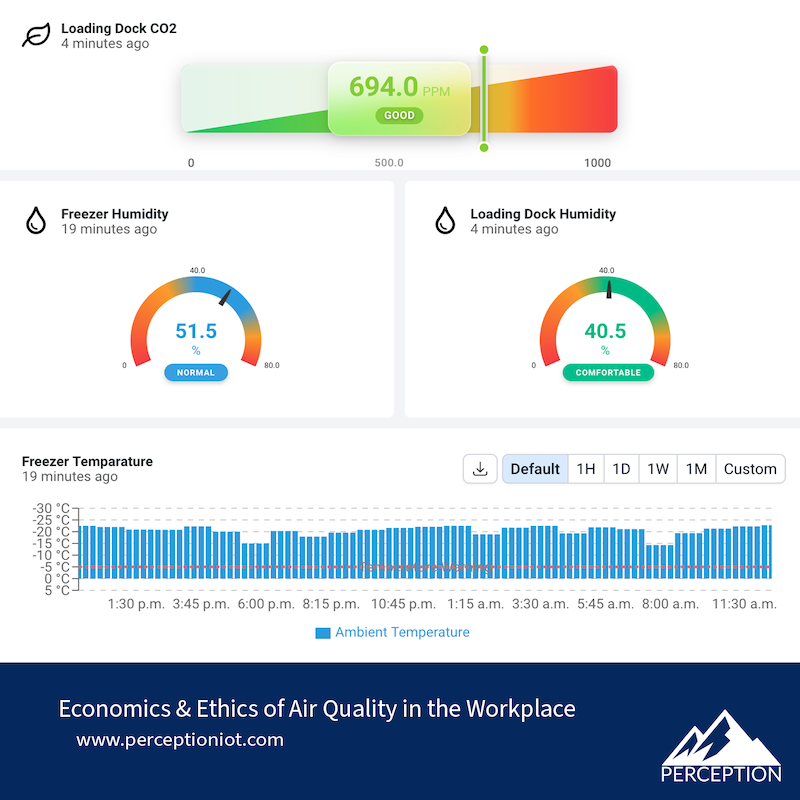
    • Environmental Sensor Networks: Integrated into larger building systems or standalone, wireless IAQ Sensors are interconnected providing users with real-time dashboards and alerts as well as historical data to build a larger picture.


    Making the Case

    Investing in air quality improvements can lead to increased productivity and can reduce absenteeism and increase employee efficiency. Reducing the risk of respiratory diseases and other health problems can lower healthcare costs while proactively improving air quality can prevent costly fines and legal issues. Companies that prioritize employee health and well-being may see increased retention and morale. ROI can be measured by tracking reductions in absenteeism, improved employee output, and savings on health insurance and medical claims.

    The options to implementing a next-generation air quality system are varied and customizable to suit virtually any budget. Starting small and with a long-term vision is arguably better than waiting for the perfect time or miracle budget. Wireless technologies including Low-Power Wide-Area Networks (LPWANs) have emerged as a cost-effective solution into sensor management and with ability to scale as time and budgets allow.

    The economics and ethics of air quality in the workspace are intertwined. Employers have both a legal obligation and an ethical duty to provide a safe, healthy work environment. With the right technology, measuring tools, and a solid financial plan, businesses can ensure that air quality standards are met, leading to a healthier workforce and improved long-term business outcomes. Work with a qualified professional to further understand the options available and how to most effectively develop a migration plan that’s right for you.

    #IOT #EnvironmentalMonitoring #AirQuality #LoRaWAN #HVAC #PerceptionIOT

  • Security & Sensing in Logistics

    Security & Sensing in Logistics

    The shipping and storage of goods, large or small, requires a level of coordination and expertise that few consider outside of the world of logistics. The layers of process, technology and oversight when done right is a testament to the countless hours of planning and hardworking people in the industry. Current geopolitical and tariff tensions further strain the supply-chain infrastructure and puts pressure on providers to do more with less. Thankfully some of the technology tools available to ensure goods are secure, delivered on time and workers are safe has evolved in recent years, and shed much of its restrictive costs.

    Security & Asset Tracking

    Protecting inventory is no longer just about locking doors—it’s about creating a smart, responsive environment where every movement is authenticated and every risk is visible. Modern access control systems, including door sensors, play a critical role in safeguarding products from both unintentional damage and deliberate tampering. Across the entire supply chain, billions of dollars of losses are written off annually with a large portion attributed to preventable operational errors and unauthorized access. Smart access monitoring directly reduces these avoidable losses.

    Video verification has emerged as one of the most impactful technologies in security operations. By validating sensor alerts with real-time or historically referenced video, companies can drastically reduce false alarms—many by up to 90%, based on data from leading alarm services providers. This not only strengthens on-site security but also increases the accuracy of incident reporting and response.

    The integration of wireless IoT sensors has expanded the depth of operational insights. For example, forklift-movement and tilt sensors offer critical telemetry that helps validate inventory handling, prevent accidents, and reduce product damage. The Occupational Safety and Health Administration (OSHA) in the U.S. estimates that more stringent training / safety policies could reduce ~70% of forklift accidents, underscoring the need for proactive, sensor-based awareness. Because today’s wireless sensors are inexpensive and easy to deploy, organizations can place dozens—or even hundreds—of data points throughout a facility without the high cost of cabling or downtime.

    Environmental monitoring, when unified with the security ecosystem, provides a holistic view of asset risk. Whether it’s temperature deviations, humidity intrusion, or air-quality alerts, tying these metrics into a centralized platform allows operators to respond swiftly and cohesively to incidents. A dynamic implementation approach further accelerates deployment, enabling rapid rollout of sensors across large facilities while minimizing operational disruption.

    Sustainability & Quality Control

    Sustainability and quality assurance are no longer optional—customers, regulators, and stakeholders expect them. Sensor data collected at the pallet or container level provides an additional layer of protection for perishables and high-value goods. The global cold chain market, which reached $328 billion in 2023 (Grand View Research), is increasingly adopting item-level or container-level IoT sensors to reduce spoilage, improve traceability, and guarantee freshness throughout the supply chain.

    Layered environmental monitoring also strengthens compliance efforts. Industries such as food production, pharmaceuticals, and logistics are required to maintain verifiable audit trails for temperature, humidity, and handling conditions. Automated IoT-driven data collection reduces manual labor while providing accurate, time-stamped records that aids in following HACCP principles.

    Traffic-mapping for personnel and forklifts is becoming a powerful tool for enhancing workplace safety. Using wireless motion and tracking sensors, organizations can identify congested pathways, unsafe driving patterns, or high-risk intersections within facilities. Studies show that data-driven traffic optimization can reduce industrial accidents by up to 25%, improving both employee safety and operational efficiency.

    Predictive maintenance is another high-impact advantage. By monitoring the performance and environmental impact of equipment—such as compressors, HVAC systems, fans, or cooling units—organizations can schedule proactive servicing before costly failures occur. According to Deloitte, predictive maintenance can reduce breakdowns by 70% and cut maintenance costs by up to 25%, offering immediate financial benefits.

    Beyond metrics like temperature and humidity, localized monitoring of Carbon Monoxide and Particulate Matter ensures personnel are working in safe environments. Research shows that improved air quality can increase worker productivity by 6–11% and decrease absenteeism. Monitoring these air-quality parameters in loading areas, underground garages, and sally ports ensures that operational spaces remain healthy and compliant with occupational safety standards.
     

    Next Steps

    There are many stakeholders in the running of any logistics facility but when dealing with quality assurance, safety and security you find few competing objectives. Sales gets a market differentiator and ability to justify healthy profit margins, Operations get more tools in their kit and Security benefits from faster, actionable data. There’s a cost of inaction, but when the true costs of inefficiencies are measured and total-cost-of-ownership is identified, the path gets clearer. More granular and accurate data allows for better, faster decision making.

    Often a single location and cost-effective Proof of Concept trial is the best starting point to seeing where the true value is for your specific needs. Partnering with a qualified Integrator that focuses on the complete life cycle of your investment can mean the difference between success and avoidable failure. It all starts with a discussion.

  • How Do We Define Smarter Facility Management Security?

    How Do We Define Smarter Facility Management Security?

    Modern organizations are looking beyond traditional security systems to gain a deeper understanding of their operations and reduce both risk and cost. By integrating electronic security with IoT environmental and asset sensors, organizations achieve a unified solution that delivers real-time insight, proactive protection, and intelligent automation across their entire working environment.


    By integrating IoT sensors—including temperature, humidity, motion, water leak, and air quality sensors—into the same security management platform, a facility gains a single source of truth for both security and operational data.


    Real-World Advantages:

    · Proactive Risk Reduction – Acting on known vulnerabilities.

    · Improved Situational Awareness – More data points to pull from.

    · Operational Efficiency and Cost Reduction – Focus resources where best utilized. 


    Wireless Sensor Networks (WSN) are a valuable extension to any security or process network, adding additional context to any emergency response and helping remove information blind spots thereby focusing your resources more effectively.


    Achieving these benefits requires more than simply connecting devices—it demands a well-qualified integrator experienced in both electronic security design and IoT network architecture.


    A unified electronic security and IoT solution transforms traditional protection systems into intelligent, data-driven infrastructures. The path is shorter and more cost effective today than it was just a few short years ago.